Why use HIPS for electronic component packaging? The answer begins with a practical balance between protection, cost, and production speed. High-impact polystyrene offers reliable stiffness, clean thermoforming, and useful impact resistance. These properties suit trays, dividers, covers, and protective inserts used around circuit boards and small components. A tray should hold its shape when stacked, yet separate easily during assembly. HIPS can support that requirement without the processing complexity of many engineering plastics.
Industry forecasts also explain the material’s continued relevance. Smithers’ report, The Future of Global Packaging to 2028, identifies ongoing demand for lightweight, cost-efficient packaging across industrial sectors. Meanwhile, Grand View Research reports continued growth in the global electronics packaging market, driven by expanding consumer electronics and semiconductor production. These figures do not prove that HIPS is always the best choice. They show why manufacturers still examine it seriously.
There is an important limitation. Standard HIPS is not naturally electrostatic-dissipative. Sensitive components may need conductive or antistatic grades, controlled surface resistance, and verified testing. Packaging engineers should check IEC 61340-5-1 practices, component sensitivity, humidity, and transport conditions before approval. In a factory, the difference can be visible: an untreated tray may attract dust, while a qualified ESD grade reduces handling risk. Recycling claims also require care, because labels, coatings, and mixed materials can complicate recovery. Based on production experience, HIPS often performs well when its limits are documented, not ignored. That is the real reason to ask why use HIPS for electronic component packaging.
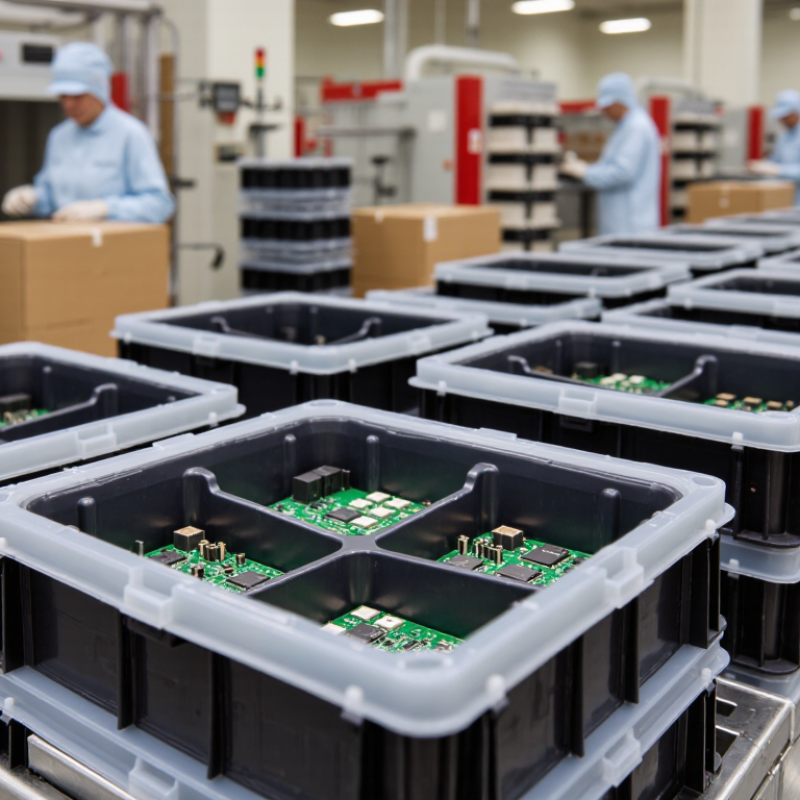
What Is HIPS and Why Is It Used in Packaging?
High Impact Polystyrene, or HIPS, is a modified form of polystyrene. Manufacturers add rubber-based components to improve its impact resistance. The result is a rigid, lightweight, and easily formed plastic sheet. HIPS can be heated and shaped into trays, inserts, covers, and compartmented packaging. These forms help keep electronic components separated during handling and transport. Less movement means fewer scratches, bent leads, and surface defects.
It is practical for many packaging designs. HIPS offers a smooth surface, consistent thickness, and accurate forming around small parts. It also supports clear labeling and efficient stacking. Its relatively low density can reduce package weight without making the structure feel weak. In production, engineers can adjust tray geometry to protect connectors, pins, or fragile edges. That detail matters.
Still, HIPS is not perfect. Its moisture barrier is limited, and high temperatures may cause deformation. Standard HIPS also does not automatically provide electrostatic protection. Packaging may require an antistatic or conductive formulation, depending on the component’s sensitivity. Testing should cover impact, compression, temperature, and electrical performance. A tray that looks strong can still fail around thin corners. This is where design review becomes essential. Cost savings may disappear if protection is treated as an afterthought.
Key Properties of HIPS for Electronic Components
Why Use HIPS for Electronic Component Packaging?
HIPS offers a practical balance of impact resistance, low weight, and stable forming performance. These properties help protect small electronic components during handling, storage, and transport. A tray made from HIPS can resist ordinary drops and edge impacts better than more brittle polystyrene grades. It also holds consistent dimensions after thermoforming. That matters when components must sit securely in narrow cavities. Less movement means fewer scratches and bent leads.
The material is naturally electrically insulating. However, standard HIPS does not provide electrostatic discharge protection by itself. Sensitive components may require conductive or dissipative additives, plus verification through appropriate testing. This point is easy to overlook.
HIPS also has a smooth surface that supports clean cavity design and clear labeling. Its lightweight structure can reduce packaging weight without making the package feel fragile. In assembly areas, operators often value its easy cutting, stacking, and visual inspection.
HIPS has limits. It can soften under excessive heat, and its moisture resistance is useful but not absolute. Packaging engineers should check temperature exposure, component weight, wall thickness, and storage duration before approval. A design may look strong but fail around thin corners. That needs testing.
Drop tests, vibration trials, dimensional checks, and static-control measurements provide more reliable evidence than appearance alone. When these conditions are controlled, HIPS can serve as a dependable packaging material for many electronic components.
How HIPS Protects Components During Storage and Transport
Why Use HIPS for Electronic Component Packaging?
During storage and transport, electronic components face vibration, pressure, dust, and accidental impacts. High-impact polystyrene, or HIPS, helps reduce these risks through rigid, lightweight packaging. Thermoformed HIPS trays can hold each component in a fixed cavity, preventing movement inside cartons. This matters when connectors, sensors, or small circuit parts travel over uneven roads.
In practical packaging tests, a well-fitted tray keeps pins aligned and limits surface contact. Its smooth walls also make loading and inspection easier. HIPS resists ordinary handling stress, while its low weight can reduce shipping burdens. Stacked trays may protect delicate parts from crushing, provided the load is distributed correctly. Small details matter.
Standard HIPS does not automatically provide electrostatic protection. Static-sensitive components may require antistatic or conductive grades, plus suitable grounding procedures. Packaging teams should verify material performance, cavity dimensions, temperature limits, and carton strength before full production. Humidity changes can also affect handling results. We have seen designs that looked secure but allowed components to shift after repeated vibration. That weakness deserves attention. Careful drop, compression, and vibration testing can reveal problems that visual checks miss.
HIPS Packaging Design, Manufacturing, and Application Options
Why Use HIPS for Electronic Component Packaging?
HIPS offers a practical balance of impact resistance, low weight, and easy processing. Its smooth surface helps protect small components from scratches during handling. The material also provides reliable electrical insulation for many standard packaging applications. Designers can create pockets, dividers, and stacking features around the component’s shape. Small radii reduce sharp contact points. Draft angles also support cleaner release from forming tools.
Packaging design depends on the component, transport method, and production volume. Thermoforming suits trays with repeated cavities and moderate tooling costs. Injection molding supports stronger details, tighter dimensions, and higher-volume production. Prototype cutting or 3D-printed tools can reveal fitting problems before final tooling. However, HIPS is not ideal for every environment. High heat, strong solvents, or strict static-control requirements may need another grade or added surface treatment. A tray may look precise but still allow movement during shipping. That weakness is easy to miss.
Tips: Keep walls reasonably uniform, check corner strength, and test filled trays under vibration. Use antistatic or conductive HIPS when static discharge could harm sensitive parts. Confirm the material grade with documented test data. Inspect for burrs, dust, and warped cavities after forming. Color can help operators identify packaging types, but it does not prove performance. Sometimes, a simpler tray works better than an attractive design.
Limitations and Selection Criteria for HIPS Packaging
HIPS is often selected for electronic component packaging because it is rigid, lightweight, and easy to thermoform. Its smooth surface can support trays, separators, and protective covers with consistent dimensions. However, material selection should begin with the component, not the packaging price.
HIPS has clear limitations. It offers limited resistance to moisture, heat, and aggressive cleaning chemicals. Prolonged exposure may cause warping or surface changes. Standard HIPS also lacks reliable electrostatic protection, which can endanger sensitive circuits during handling. Conductive or dissipative grades may help, but their performance depends on additives, humidity, thickness, and grounding conditions. Test the actual package.
Fit matters greatly. Engineers should check cavity depth, corner radius, wall thickness, and part retention during vibration tests. Sharp edges can scratch housings or damage leads. A tray that feels strong in the warehouse may crack after repeated transport. It happens. Cleanliness also deserves attention, especially when exposed contacts enter the package. Request measurable limits for particles, odor, and surface resistance rather than accepting vague claims. Packaging teams should review temperature ranges, stacking loads, recycling routes, and storage time before approval. A small pilot run can reveal problems that drawings miss. The first sample is rarely perfect. Cost remains important, but a cheaper tray may create more waste through rejected components, poor nesting, or unstable dimensions. Selection should balance protection, manufacturability, verification data, and the real handling environment.
Why Use HIPS for Electronic Component Packaging?
HIPS offers a practical balance of low density, stiffness, easy thermoforming, and low cost for trays, inserts, and protective packaging. Its main limitations are moderate mechanical strength, limited heat resistance, and reduced resistance to solvents and impact compared with some alternative plastics.
The chart shows representative midpoint values from commonly published room-temperature tensile-strength ranges: HIPS 20–35 MPa, PP 25–40 MPa, HDPE 20–30 MPa, and PET 50–75 MPa. Actual performance depends on grade, wall thickness, processing conditions, additives, and test method. Select HIPS when thermoformability, stiffness, surface protection, and cost are more important than high heat resistance, chemical resistance, or maximum mechanical strength.
FAQS
HIPS is lightweight, rigid, and suitable for thermoforming. It can protect small parts from ordinary drops and edge impacts. Its stable shape helps components stay inside narrow cavities.
No. Standard HIPS is electrically insulating but does not provide reliable electrostatic discharge protection. Sensitive circuits may need conductive or dissipative additives. Test the finished package.
Check cavity depth, corner radius, wall thickness, and part retention. Smooth edges can reduce scratches and bent leads. Thin corners may fail, even when the tray looks strong.
Only within controlled limits. Excessive heat can soften or warp the material. Moisture resistance is useful, but not absolute. Review temperature, humidity, and storage duration.
Use drop tests, vibration trials, dimensional checks, and static-control measurements. Inspect the tray after repeated handling. Appearance alone proves very little.
Define limits for particles, odor, and surface resistance. This matters when exposed contacts enter the package. Vague cleanliness claims are not enough.
Yes. Their lightweight structure can reduce total package weight. Operators may also find them easy to cut, stack, and inspect. Small handling gains matter.
Not always. A cheaper tray may increase waste through rejected parts, poor nesting, or unstable dimensions. A small pilot run can expose hidden problems. The first sample is rarely perfect.
Conclusion
HIPS, or high-impact polystyrene, is a practical thermoplastic widely used to produce protective packaging for electronic components. Its balance of stiffness, impact resistance, light weight, and cost efficiency makes it suitable for trays, inserts, boxes, and compartmentalized containers. The question “why use HIPS for electronic component packaging” can be answered by its ability to hold components securely, reduce movement during handling, and help protect surfaces from scratches, dust, and moderate physical shock. It can also be formed into precise shapes that match different component sizes and packaging requirements.
HIPS packaging can be designed through thermoforming, injection molding, or other conversion methods, allowing manufacturers to select reusable or disposable formats for storage, transport, and production-line use. However, HIPS has limitations, including limited resistance to high temperatures, certain chemicals, and static electricity unless specially modified. Selection should therefore consider component sensitivity, environmental conditions, required strength, dimensional accuracy, antistatic needs, packaging volume, and total cost. With these factors properly evaluated, HIPS can provide dependable and efficient protection for many electronic components.

 Benchmark Plastic