Why Is a High Gloss Finish on HIPS Sheets Difficult?
High gloss looks simple under showroom lighting. It is not. HIPS sheets can show flow lines, orange peel, die lines, and tiny haze patches within seconds of extrusion. The surface reflects every processing mistake. A small temperature imbalance may become visible across an entire white sheet.
The wider plastics industry also explains why consistency matters. PlasticsEurope’s Plastics—The Fast Facts 2024 reported global plastics production of approximately 413.8 million tonnes in 2023. Meanwhile, the European Commission’s Best Available Techniques reference documents emphasize stable processing conditions, efficient cooling, and reduced production waste. These principles apply directly to HIPS sheet extrusion. However, they do not provide a universal gloss recipe. That assumption is incomplete.
So, how to achieve high gloss finish on HIPS sheets? The answer begins with resin selection, melt filtration, die-lip cleanliness, and controlled roll temperature. A polished chill-roll surface can transfer a sharper image, but excessive cooling may create stress and uneven shrinkage. Higher melt temperature can improve flow, yet it can also increase degradation or discoloration. The process window is narrow. Sometimes, experience still loses to an unclean die.
Plastics-processing expert John Bozzelli states, “You cannot inspect quality into a part; you must build it in.” His principle is especially relevant here. Gloss must be developed during extrusion, not repaired during final inspection. Operators should measure gloss at a defined angle, record haze, and compare readings across the sheet width. Without that discipline, visual approval remains subjective, inconsistent, and difficult to repeat.
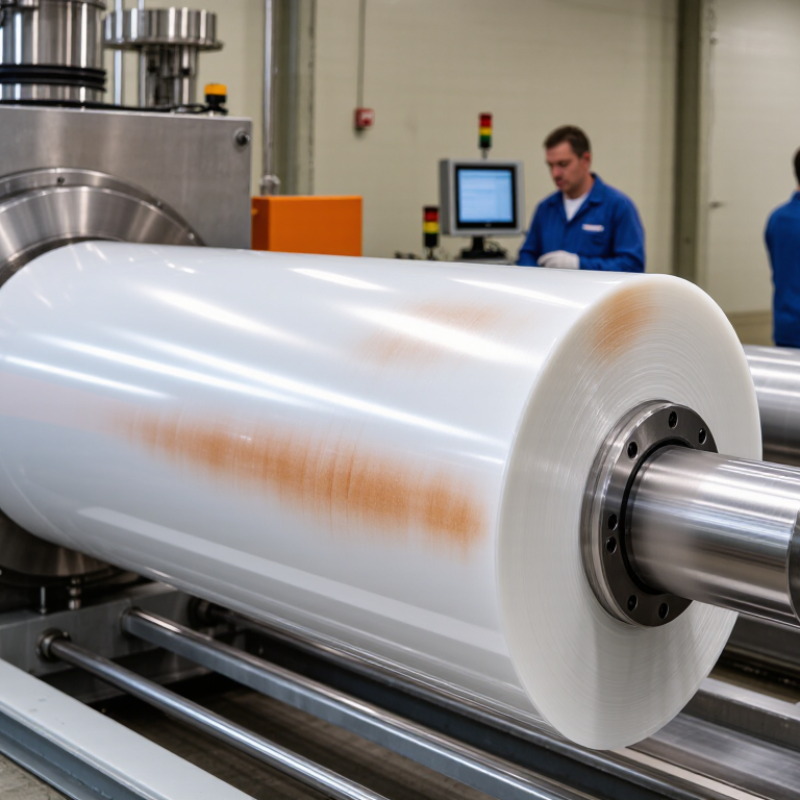
Why Is a High Gloss Finish on HIPS Sheets Difficult?
What High Gloss Means in HIPS Sheets
High gloss does not simply mean “shiny plastic.” Under ISO 2813:2014, gloss is measured by directing light onto the sheet and recording reflected intensity. For many converters, a 60° reading above 70 gloss units is a practical high-gloss benchmark. However, this threshold is not a universal HIPS rule. ASTM D2457-21 also recognizes 20°, 60°, and 85° measurement angles for different surface conditions.
The number alone can mislead. A sheet may reach 75 gloss units but still show flow lines, haze, or uneven reflection. High gloss means the surface reflects light consistently. It does not guarantee perfect appearance. I once treated gloss as a simple molding target. That assumption was too simple.
HIPS contains a rubber-modified phase that improves impact resistance but complicates surface replication. Cooling differences can create tiny waves across a wide sheet. Excessive melt temperature may improve flow, yet it can increase degradation risk. Mold texture, pigment dispersion, screw design, and polishing quality also affect reflected light. Thermoforming can reduce gloss when stretching exposes microscopic surface variations. Plastics production reached about 400.3 million tonnes globally in 2022, according to PlasticsEurope’s Plastics—The Fast Facts 2023 report. That scale highlights the need for repeatable measurement, not visual judgment alone. Production teams should record gloss angle, location, temperature, and processing history. Small gaps in testing remain easy to overlook.
Why Is a High Gloss Finish on HIPS Sheets Difficult?
High-impact polystyrene contains a rigid polystyrene matrix and dispersed rubber particles. This structure improves toughness, but it also disturbs surface reflection. Light meets tiny phase boundaries beneath the surface and scatters instead of traveling evenly. The result is a softer, hazier appearance.
Processing adds another challenge. During extrusion, rubber particles can stretch, cooling can freeze uneven flow marks, and microscopic die lines may remain visible. A smooth mold or polished roll can replicate a bright surface, but it cannot fully remove internal light scattering. ISO 2813 recommends 60° gloss for general surfaces, while 20° geometry is used for very high gloss. That measurement difference matters. A sheet may look bright under factory lighting yet record a modest gloss value.
Industry data also explains the pressure for better appearance. PlasticsEurope’s 2023 industry report identifies packaging as roughly 40% of European plastics demand, where visible surfaces strongly influence product acceptance. For HIPS, operators often adjust melt temperature, cooling speed, roll pressure, and rubber content together. Small changes can produce orange peel, flow bands, or uneven reflection. I have found that slower cooling sometimes improves surface replication, but it can reduce dimensional stability. That trade-off is easy to underestimate. High gloss is not only a polishing problem. It is a material-structure problem.
| Material or Process Dimension | Typical Data or Range | Structural or Physical Basis | Effect on Surface Reflectivity | Practical Interpretation for HIPS Sheets |
|---|---|---|---|---|
| Polymer matrix | Amorphous thermoplastic; glass-transition temperature typically about 90–105°C | HIPS uses a continuous polystyrene-rich matrix containing dispersed rubber particles. Unlike crystalline polymers, it does not develop ordered crystallites that can create a uniform optical surface. | The amorphous matrix can produce good transparency of reflection when smooth, but local phase differences can scatter incident light. | High gloss is possible, but it depends strongly on surface smoothness and the uniformity of the dispersed rubber phase. |
| Rubber-phase dispersion | Rubber domains commonly occur from submicron scale to several micrometres, depending on grade and processing | HIPS contains a rubber phase, commonly polybutadiene-based, dispersed within the polystyrene matrix. Domain size and distribution influence light scattering. | Large, irregular, or poorly dispersed domains increase diffuse reflection and reduce mirror-like gloss. | High-gloss grades generally require a fine, uniform morphology and carefully controlled compounding and extrusion conditions. |
| Refractive-index mismatch | Polystyrene-rich phase: approximately 1.59 at visible wavelengths; rubber phase is typically lower and formulation-dependent | Light changes direction at interfaces where adjacent phases have different refractive indices. | Greater optical mismatch increases internal scattering, making the surface appear hazier or less reflective even when it feels smooth. | Surface gloss cannot be predicted from roughness alone; internal morphology also contributes to optical loss. |
| Surface roughness | Smooth polished surfaces may have Ra below 0.1 µm; textured surfaces are commonly much higher | Surface peaks and valleys redirect reflected light away from the specular direction. | Lower Ra generally produces higher gloss, while increasing roughness changes reflection from concentrated specular reflection to diffuse reflection. | Polished rolls, clean tooling, and stable draw-down are important when a high-gloss appearance is required. |
| Gloss measurement geometry | 60° gloss is the general-purpose geometry; 20° is used for high-gloss surfaces and 85° for low-gloss surfaces | Gloss values depend on the angle of illumination and observation. The same sheet can show different values at 20°, 60°, and 85°. | A numerical gloss value is meaningful only when the measurement angle and standard are reported. | Use a consistent method such as ASTM D523 or ISO 2813 and report the angle with the gloss result. |
| Melt temperature | Typical HIPS processing melt temperatures are approximately 200–260°C, grade-dependent | A hotter, sufficiently fluid melt can replicate a polished roll or die surface more effectively before solidification. | Insufficient melt temperature can cause incomplete surface replication, flow lines, and a dull appearance. Excessive temperature may promote degradation or volatile defects. | Use the supplier’s recommended processing window and avoid treating higher temperature as a universal solution for gloss. |
| Roll or mold surface temperature | Common processing conditions are often approximately 40–80°C, depending on sheet thickness and equipment | Rapid cooling can freeze surface irregularities before the polymer fully conforms to the polished surface. | A controlled increase in surface temperature often improves gloss by improving surface replication and reducing premature skin formation. | Temperature uniformity across the width is as important as the average temperature; uneven cooling can create gloss bands. |
| Flow orientation and weld-like marks | Orientation is highest near die lips, chill-roll contact zones, thickness transitions, and constrained flow regions | Shear aligns polymer chains and can orient rubber domains. Different orientations may produce direction-dependent scattering and shrinkage. | Flow lines, die lines, and orientation bands can reflect light differently from surrounding areas, reducing visual uniformity. | Stable die pressure, uniform gap settings, and balanced cooling help minimize gloss variation across the sheet. |
| Moisture and surface contamination | HIPS generally has low moisture absorption, but dust, oil, and condensation can remain optically significant | Particles and thin contaminant films create local changes in surface height and refractive index. | Even small contaminants can produce visible haze, pinpoints, fish-eyes, or local loss of specular reflection. | Keep the melt path, rolls, trimming equipment, and handling surfaces clean; inspect both sides of the sheet. |
| Thickness uniformity | The acceptable tolerance depends on sheet specification; local thickness changes can alter cooling and shrinkage | Uneven thickness changes the thermal history and can create differential shrinkage, stress, and surface deformation. | Gloss may vary with thickness because surface replication and internal scattering are affected by local cooling conditions. | Monitor cross-web thickness profiles together with gloss profiles to identify process-related bands. |
| Internal stress and post-shrinkage | Stress level is process-dependent and increases with severe cooling gradients or excessive orientation | Frozen-in stress can relax after processing, causing small dimensional or surface changes over time. | Stress relaxation may lead to waviness, distortion, or changes in the direction and intensity of reflected light. | Use balanced cooling and avoid unnecessarily high draw ratios when dimensional stability and gloss uniformity are required. |
| Surface texture or embossing | Texture depth and pitch may range from submicrometre optical textures to visibly patterned surfaces | Texture intentionally redistributes reflected light over a wider range of angles. | Increasing texture usually lowers measured gloss but can reduce visible fingerprints, glare, or perceived surface defects. | A lower gloss value is not always a quality failure; it may be the intended optical design of the sheet. |
Why Is a High Gloss Finish on HIPS Sheets Difficult?
High gloss on HIPS sheets depends on more than resin selection. The molten surface must replicate the die and chill-roll finish almost perfectly. Processing data for polystyrene extrusion commonly places melt temperatures near 200–240°C. Even small temperature shifts can change flow behavior and surface replication.
A melt that is too cold may leave fine flow lines, while excessive heat can increase degradation and create yellowing. That assumption is too neat. Actual results also depend on residence time, screw design, and die pressure stability. A worn die lip can produce dull streaks across an otherwise bright sheet. Chill-roll temperature and contact pressure matter as well. Poor contact traps microscopic air pockets. The surface then loses its mirror effect.
Line speed creates another compromise. Faster output reduces cooling time and may prevent complete surface replication. Slower speeds can improve gloss, but they may increase thermal exposure. Industrial troubleshooting guidance often treats stable die temperature within about ±2°C as a practical control target, although each line behaves differently. Operators should measure, not guess. Gloss testing at 60 degrees follows ASTM D523-14(2023), while ISO 2813:2014 provides a comparable measurement framework. Values above 70 gloss units are often viewed as visually bright, but the acceptable target depends on texture and application. Small defects matter. Dust, moisture, and die buildup can reduce readings before the defect becomes obvious. A clean line is not always a glossy line.
Processing factors that reduce gloss during sheet production
The chart shows a representative 60° gloss measurement for HIPS sheet surfaces under common processing conditions. Higher melt temperature and faster, more uniform cooling generally improve surface replication, while excessive die temperature, melt fracture, moisture, and uneven cooling can create surface irregularities that reduce gloss.
A high gloss HIPS sheet reflects every small surface change. Tiny height differences scatter light and create cloudy or dull areas. Orange peel is a frequent defect. It appears as a fine, uneven texture across the sheet. The surface may feel smooth, but the reflection looks broken.
Flow lines can form when the melt temperature or flow rate changes during extrusion. These lines often appear as bands with different gloss levels. Die lines are more defined. They may result from residue, wear, or a small gap variation at the die lip. I have seen one narrow line continue across an entire roll. It was easy to miss during a quick inspection.
Cooling also affects appearance. Uneven roller temperature can freeze one area faster than another. Shrinkage then creates slight waviness or gloss variation. Contamination makes the problem worse. A tiny particle may leave a crater, streak, or raised mark. Excessive shear can create melt fracture, giving the sheet a rough, dull finish.
My first assumption was that low gloss always came from poor polishing. That was too simple. Process stability, cleaning, temperature control, and roller contact all matter. The inspection method matters too. Different lighting angles can reveal defects that standard lighting hides. This is where production teams sometimes need to question their own testing routine.
Achieving high gloss on HIPS sheets is difficult because the surface records small processing changes. Its rubber-modified structure can scatter light when the sheet becomes slightly rough. Melt temperature, cooling speed, die condition, and roller pressure all influence the final appearance. Even tiny contamination may create dull streaks, silver marks, or uneven reflections.
Improvement starts with a clean, highly polished die and calendering rollers. Keep the melt temperature stable instead of increasing heat aggressively. Excessive heat can cause degradation and color changes. A steady cooling rate helps reduce surface stress and shrinkage. Operators should also check screen packs, filters, and material storage conditions. In practical production, the first trial is rarely perfect. One setting may improve gloss but reduce dimensional stability. That trade-off needs careful measurement, not guesswork.
Tips: Measure gloss at the same angle and lighting each time. Clean rollers with approved, non-abrasive tools. Store sheets flat, covered, and away from dust. Avoid stacking warm sheets, because pressure can imprint the surface. Inspect the die lip regularly; a small buildup can leave a continuous dull line. Protective film can preserve gloss during handling, but poor film application may trap marks. It is easy to blame the resin when the real problem is uneven cooling or careless packaging.
HIPS contains rubber particles inside a rigid plastic matrix. These particles scatter light beneath the surface. The sheet may look hazy.
Tiny phase boundaries interrupt smooth light travel. Instead of one clear reflection, light spreads in several directions.
Uneven cooling, stretched rubber particles, die lines, and unstable melt temperature can create dull areas or flow bands.
Polished rollers improve surface replication. However, they cannot remove internal light scattering. The result may still appear softer.
Monitor melt temperature, cooling speed, roller pressure, and rubber content together. Changing one setting may create another problem.
Not always. Slower cooling can improve surface replication, but it may reduce dimensional stability. That trade-off is easy to miss.
Use the same measurement angle and lighting every time. A 60-degree reading suits general surfaces, while 20 degrees suits very high gloss.
Store sheets flat, covered, and away from dust. Do not stack warm sheets. Pressure can imprint visible marks.
Look for orange peel, silver marks, dull streaks, and uneven reflection. Check the die lip for buildup. Small buildup can create one continuous line.
No. Uneven cooling, dirty filters, contamination, or careless packaging may be the real causes. The first setting is rarely perfect.
Achieving a high gloss finish on HIPS sheets requires more than simply polishing the surface. High gloss refers to the sheet’s ability to reflect light evenly and clearly, which depends on the material’s molecular structure, surface smoothness, and processing stability. Because HIPS contains rubber-modified regions that can affect light transmission and reflection, its natural surface may appear less uniform than that of some other plastics. During production, factors such as melt temperature, cooling speed, extrusion pressure, die condition, and roller finish can reduce gloss or create inconsistent reflections.
Common defects, including flow marks, fine scratches, haze, orange peel, and uneven cooling, may further lower the visual quality of the sheet. To understand how to achieve high gloss finish on HIPS sheets, manufacturers should carefully control raw material consistency, processing temperatures, line speed, and polishing conditions. Clean equipment, properly maintained rollers, suitable storage, and protective handling are also important for preserving gloss after production. Consistent inspection and process adjustment can help maintain a smooth, bright, and uniform surface.

Benchmark Plastic